FOOTBALL
๐Ÿˆ EMU Crows โ€” Complete Football Guide

LEARN
AMERICAN
FOOTBALL

From the first snap to the final whistle โ€” master the rules, positions, formations, and strategy behind one of the world's most tactical sports.

11
Players per side
4
Downs to gain 10 yds
60
Minutes of play
100
Yards long

Watch & Learn

FOOTBALL 101 โ€” VIDEO

The best way to learn football is to watch it explained. Start here.

FEATURED NFL ยท Beginner
How American Football Works

A clear, concise breakdown of downs, scoring, positions, and the flow of the game โ€” perfect if you've never watched football before.

NFL Rules
โ–ถ
Rules
The Rules of American Football โ€” Explained!
Penalties, challenges, replay โ€” the full rulebook made simple.
Offense
โ–ถ
Offense
Understanding Football Offense
Positions, formations, and how the offense moves the ball.
Defense
โ–ถ
Defense
A Fan's Guide to American Football Defense
Cover 2, Cover 3, man coverage โ€” how defenses shut down offenses.
Positions
โ–ถ
Positions
Guide to American Football Positions
What every one of the 22 players on the field actually does.

The Basics

HOW THE GAME WORKS

Eight things every fan needs to understand before kickoff.

1 ๐ŸŸ๏ธ
THE FIELD

100 yards long, 53โ…“ yards wide โ€” plus two 10-yard end zones. Every 5 yards is marked, with yardage numbers at every 10. Hash marks split the field into thirds vertically. The game starts at each team's 35-yard line on kickoffs.

2 ๐Ÿค
THE SNAP

Every play starts with the center snapping the ball to the QB. The offense sets in formation, the QB reads the defense, then calls signals โ€” "hut!" โ€” to start the play. Nothing happens until the ball is snapped.

3 โฌ‡๏ธ
4 DOWNS

The offense gets 4 attempts (downs) to advance 10 yards. Gain 10 yards and the count resets to 1st-and-10. Most teams punt on 4th down rather than risk giving the ball to the opponent in good field position.

4 ๐Ÿ†
SCORING

A touchdown is worth 6 points โ€” scored by crossing the goal line with the ball. The scoring team then attempts either a kick (1 pt) or a run/pass into the end zone (2 pts). Field goals and safeties round out the ways to score.

5 โฑ๏ธ
GAME CLOCK

Four 15-minute quarters (60 minutes total). The clock stops on incomplete passes, out-of-bounds plays, penalties, and timeouts. Each team gets 3 timeouts per half. A 2-minute warning also stops the clock near the end of each half.

6 ๐Ÿ”„
TURNOVERS

Possession changes via an interception (pass caught by a defender), a fumble recovery (the ball carrier loses the ball and defense recovers), or a turnover on downs (failing to convert on 4th down). All are momentum-shifting events.

7 ๐Ÿ‘Ÿ
KICKOFF

The kicking team lines up at their 35-yard line and kicks the ball downfield. The receiving team tries to return it as far as possible. A touchback (ball caught in the end zone and downed) spots the ball at the 25-yard line.

8 โšก
OVERTIME

Tied games go to OT. In the NFL, each team gets one possession; if still tied, the next score wins. In college ball, teams alternate from the 25-yard line each OT period. After the 2nd OT, teams must attempt 2-point conversions.

Core Mechanic

THE DOWN SYSTEM

The most important concept in football โ€” four chances to move 10 yards.

โ†’
1ST
Down
& 10
Fresh set of downs. The offense has maximum freedom to call any play. Teams often run here to set up later downs.
โ†’
2ND
Down
& varies
If 1st down gained 4 yards, it's 2nd & 6. Offense balances between run and pass based on yards needed.
โ†’
3RD
Down
& critical
The most watched down. If it's 3rd & 8+, defense expects a pass. Converting 3rd down keeps drives alive.
4TH
Down
Decision time
The offense chooses: go for it, kick a field goal, or punt. Going for it and failing gives the opponent the ball at that spot.
โœ…
FIRST DOWN GAINED

The offense gains 10+ yards โ€” the chain moves, the count resets to 1st & 10, and the drive continues. This is what the offense is always fighting for.

๐Ÿ†
TOUCHDOWN

The ball reaches the end zone on any down. Play stops, the scoring team celebrates, and they attempt the extra point or 2-point conversion.

๐Ÿ‘Ÿ
PUNT (4TH DOWN)

If the offense can't convert and is too far for a field goal, they punt โ€” deliberately kicking the ball downfield to give the opponent poor field position.

โŒ
TURNOVER ON DOWNS

Fail to gain 10 yards in 4 attempts and the defense takes possession at the exact spot the ball was when the play ended. A major momentum swing.

Points

SCORING BREAKDOWN

Every way a team can put points on the board.

6
Points
Touchdown
Ball carried or caught across the opponent's goal line. The most valuable scoring play in football.
Any down
3
Points
Field Goal
Ball kicked through the upright posts during a scrimmage play. Usually attempted on 4th down in scoring range.
Typically 4th down
2
Points
Two-Point Conv.
Run or pass into the end zone from the 2-yard line after a touchdown. A high-risk, high-reward choice.
After TD only
1
Point
Extra Point (PAT)
Kick through the uprights from the 15-yard line after a touchdown. Successful over 99% of the time in the NFL.
After TD only
2
Points
Safety
Offensive player tackled with the ball in their own end zone. Defense scores, and the offense must kick the ball away.
Defense scores

Roster

PLAYER POSITIONS

11 players per side, each with a defined role and responsibility.

๐Ÿˆ
QB
Offense
Quarterback

The field general. Calls plays in the huddle, reads defensive coverage pre-snap, and decides to pass, hand off, or scramble. Controls the tempo of the entire offense.

LeaderPasserDecision Maker
๐Ÿƒ
RB
Offense
Running Back

Takes handoffs and finds gaps in the defensive line. Also a weapon in the passing game โ€” screens and check-downs. Must read blocks, break tackles, and protect the football.

SpeedPowerVision
๐Ÿ’ช
FB
Offense
Fullback

The lead blocker ahead of the running back in I-Formation sets. Larger and more physical than a HB. Also used as a short-yardage receiver and in goal-line packages.

BlockerShort YardagePhysical
๐Ÿ™Œ
WR
Offense
Wide Receiver

Lines up on the outside or in the slot and runs precise routes โ€” cuts, comebacks, post routes, go routes โ€” to get open. Success requires elite speed, sharp route running, and reliable hands.

RoutesSpeedHands
๐Ÿฆพ
TE
Offense
Tight End

Hybrid blocker-receiver who lines up next to the offensive tackle. Blocks on run plays, runs routes on passing plays. The modern TE is one of the most versatile and matchup-proof positions in football.

BlockerReceiverMismatch
๐Ÿงฑ
OL
Offense
Offensive Line

Five players โ€” Center (snaps the ball), two Guards, two Tackles โ€” who create the QB's pocket and open running lanes. The most physically demanding unit. A great OL makes every skill player better.

Pass ProtectionRun BlockingStrength
๐Ÿ›ก๏ธ
DL
Defense
Defensive Line

DTs (Defensive Tackles) and DEs (Defensive Ends) line up against the OL. DTs clog the middle; DEs rush from the edge. A dominant DL disrupts every run and pressures the QB without blitzing.

Pass RushRun StopGap Control
โš”๏ธ
LB
Defense
Linebacker

MLB (Middle), WLB (Weak-side), SLB (Strong-side). They stop the run, blitz the QB, and drop into coverage. The defensive signal-caller, responsible for communicating coverages and adjustments at the line.

Run StuffingBlitzCoverage
๐Ÿ”’
CB
Defense
Cornerback

Lines up against wide receivers in man or zone coverage. Elite CBs take away an entire side of the field. Their stats are pass breakups and interceptions โ€” often the result of matching up 1-on-1 for entire games.

Man CoverageZoneInterceptions
๐Ÿฆ…
S
Defense
Safety

Two safeties per defense โ€” Free Safety (roams deep, centerfield) and Strong Safety (plays near the box, closer to the line). The last line of defense. If they miss a tackle, it's a touchdown.

Deep CoverageRun SupportLast Line
๐Ÿ‘Ÿ
K
Special Teams
Kicker

Handles kickoffs, field goal attempts, and extra points. A reliable kicker is a 3-point weapon from inside 55 yards. Misses are memorable โ€” kickers live under massive pressure on game-deciding kicks.

AccuracyLeg StrengthComposure
๐Ÿฆต
P
Special Teams
Punter

Kicks on 4th down when neither a field goal nor going for it makes sense. Great punters pin opponents inside their own 10-yard line โ€” a "coffin corner" punt shifts field position dramatically.

Hang TimeDirectional KickField Position

Strategy

COMMON FORMATIONS

How teams line up tells you everything about what they plan to do.

SHOTGUN
Offense โ€” Passing Formation
WR C TE WR QB RB SL โ–ฒ DEFENSE

QB lines up 5โ€“7 yards behind center in a "gun" stance. Gives the QB a pre-snap view of the whole defense and extra time to read the field. Standard for obvious passing situations.

Best for: 3rd & long, two-minute drill, spread passing attacks
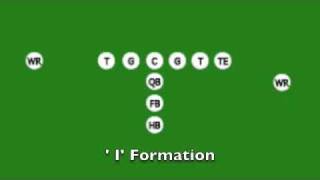
I-FORMATION
Offense โ€” Run-Heavy Formation
WR C TE WR QB FB HB โ–ฒ DEFENSE

QB under center, FB directly behind, RB (HB) 5 yards deep. Classic run formation โ€” the FB leads through the hole as a blocker. Power, misdirection, and play-action play are all built into this set.

Best for: power running, goal-line, play-action passing
4-3 DEFENSE
Defense โ€” Base Formation
DE DT DT DE WLB MLB SLB CB CB SS FS โ–ผ OFFENSE

4 defensive linemen, 3 linebackers, 4 defensive backs. The most common base defense in football. Strong against the run, with 4-man pressure and linebacker flexibility to blitz or drop into coverage.

Best for: stopping the run, balanced pressure, standard downs
3-4 DEFENSE
Defense โ€” Pass-Rush Formation
DE NT DE OLB ILB ILB OLB CB CB SS FS โ–ผ OFFENSE

3 defensive linemen, 4 linebackers, 4 defensive backs. The NT (nose tackle) absorbs double teams, freeing the OLBs to rush from the edge. Creates disguise โ€” the offense can't tell who's blitzing.

Best for: pass rush disguise, generating pressure with LBs

Interactive

THE FOOTBALL FIELD

I-Formation offense vs. 4-3 defense. Click any player to learn their role.

Offense (I-Formation)
Defense (4-3)
Line of Scrimmage
102030 405040 302010 102030 405040 302010 END ZONE END ZONE LoS LT LG C RG RT TE WR WR QB FB HB RE DT DT LE WLB MLB SLB CB CB SS FS
๐Ÿˆ
Click any player on the field above to learn their role

Rule Book

KEY PENALTIES

Yellow flag on the play โ€” here's what the referee is calling.

๐Ÿšฉ
Offense
โˆ’5 YDS
False Start

An offensive player moves after lining up and before the snap. The ball is moved back 5 yards. One of the most common penalties in football.

๐Ÿšฉ
Offense
โˆ’10 YDS
Holding

An offensive lineman grabs or wraps a defender's jersey or body to prevent them from making a play. Extremely common โ€” refs choose when to call it.

๐Ÿšฉ
Offense
โˆ’5 YDS
Delay of Game

The offense fails to snap the ball before the 40-second play clock expires. Free timeouts or slow huddles cause this โ€” the ball moves back 5 yards.

๐Ÿšฉ
Offense
โˆ’10 YDS
Illegal Block in the Back

A blocker hits a defender in the back or shoulders from behind on a kick return. Common on special teams and kickoff returns.

๐Ÿšฉ
Defense
โˆ’5 YDS
Offside

A defensive player is in or crosses the neutral zone before the snap. The offense gets an automatic 5-yard gain and a free play โ€” the QB can take a shot downfield with no risk.

๐Ÿšฉ
Defense
Spot foul
Pass Interference

A defender interferes with a receiver's ability to catch a pass. In the NFL, the penalty is spotted at the foul โ€” potentially giving the offense 40+ yards in one call.

๐Ÿšฉ
Defense
โˆ’15 YDS
Roughing the Passer

A defender hits the QB after the ball is released or dives on their legs. Protecting the QB is a priority โ€” this penalty also gives the offense an automatic first down.

๐Ÿšฉ
Defense
โˆ’15 YDS
Unnecessary Roughness

A late hit, excessive force, or any contact deemed dangerous or unsportsmanlike. Ejection possible for targeting the head. Always an automatic first down.

Terminology

FOOTBALL GLOSSARY

Every term you'll hear during a broadcast, explained.

Blitzโ–พ
When extra defenders โ€” typically linebackers or defensive backs โ€” rush the QB rather than dropping into coverage. A blitz adds pass-rush pressure but leaves fewer defenders in coverage, gambling that the QB won't make the right read.
Pocketโ–พ
The protected area formed by the offensive line behind the line of scrimmage. The QB stands in the pocket, steps up, and throws. Collapsing the pocket is the defense's goal; protecting it is the OL's job.
Red ZoneInside 20โ–พ
The area from the defense's 20-yard line to their goal line. Scoring here is harder because the defense has less territory to cover. Red zone efficiency (points per trip) is one of the most telling stats in football.
Sackโ–พ
When a defender tackles the QB behind the line of scrimmage while he's attempting to pass. The ball is marked where the QB was tackled โ€” often a 5โ€“10 yard loss. One of the most impactful defensive plays.
Snapโ–พ
The center passes (snaps) the ball through his legs to the QB to start every single play. Under center, the QB's hands are directly under the center. In shotgun, the ball is snapped 5โ€“7 yards back through the air.
Play Actionโ–พ
A passing play disguised as a run. The QB fakes a handoff to the RB, hoping to freeze linebackers and safeties, then throws downfield. Most effective when a team has shown a strong running game.
Scrambleโ–พ
When the QB leaves the pocket to run with the ball โ€” either because pressure collapses the pocket or because no receivers are open. A QB who scrambles effectively adds another dimension to the offense that defenses must prepare for.
Audibleโ–พ
A last-second play change called by the QB at the line of scrimmage after reading the defense. The QB shouts coded signals ("Omaha!") to tell teammates the play has changed. Peyton Manning was famous for his audibles.
Two-Minute Drillโ–พ
A fast-paced offensive strategy used near the end of a half or game, designed to move the ball quickly while conserving the clock. Teams hurry to the line, spike the ball to stop the clock, and spread receivers wide.
Hail Maryโ–พ
A desperation pass thrown as far downfield as possible, usually on the last play of a half or game. Named after the Catholic prayer. Everyone runs to the end zone and the QB heaves it โ€” chaos ensues in the end zone as players jump for the ball.
Onside Kickโ–พ
A surprise kickoff where the kicking team kicks short, trying to recover it themselves. The ball must travel 10 yards and the kicking team can then legally recover it. A last-resort play when a team is losing late in a game.
CoverageZone / Manโ–พ
How the defense covers receivers in the passing game. Man coverage assigns each DB to shadow a specific receiver. Zone coverage assigns each DB to a geographic area of the field. Cover 2, Cover 3, and Cover 4 are common zone schemes.
Field Goal Rangeโ–พ
The area of the field where a kicker can reliably attempt a field goal. Most NFL kickers are reliable from inside 50 yards. Elite kickers attempt 55โ€“60 yard field goals. In college, the attempt range is generally shorter.
Turnoverโ–พ
Any time the offense loses possession to the defense โ€” via interception, fumble recovery, or turnover on downs. Teams that win the turnover battle (+2 or more) win over 80% of games. Turnovers are the single biggest indicator of game outcomes.
Nickel / DimeDB packagesโ–พ
Defensive packages using extra defensive backs. Nickel = 5 DBs (replacing a LB). Dime = 6 DBs. Used in obvious passing situations to add speed and coverage to the secondary. Named after coins โ€” nickel (5 cents), dime (10 cents).
4th Down Conversionโ–พ
When the offense succeeds in gaining the required yards on 4th down instead of punting or kicking. A successful 4th-down conversion is a massive momentum play โ€” statistically, going for it on 4th & short is often the mathematically correct call.
End Around / Reverseโ–พ
A trick run play. The QB hands off to a WR running horizontally across the backfield (end around) or a second handoff is added to another receiver running the opposite direction (reverse). Designed to catch the defense flowing the wrong way.
Clock Managementโ–พ
The strategic use of timeouts, out-of-bounds plays, spikes, and play-calling to control the game clock. A leading team runs the clock down to prevent the opponent from getting more possessions. Poor clock management can cost teams games.
Special Teamsโ–พ
The third phase of football beyond offense and defense. Covers kickoffs, kick returns, punts, punt returns, field goals, and extra points. A blocked punt or big return can completely change a game โ€” special teams is the most overlooked key phase of football.
The ChainsFirst Down Markerโ–พ
The yellow first-down marker on the sideline connected by a 10-yard chain to where the ball was at 1st down. Officials use this to measure whether a team gained the required 10 yards. When it's close, the chain crew brings the measuring stick onto the field.
READY TO PLAY?

Now that you understand the game, meet the teams and see these concepts in action on the field.